

Wiyaka Studios publication
AI in Indian Country
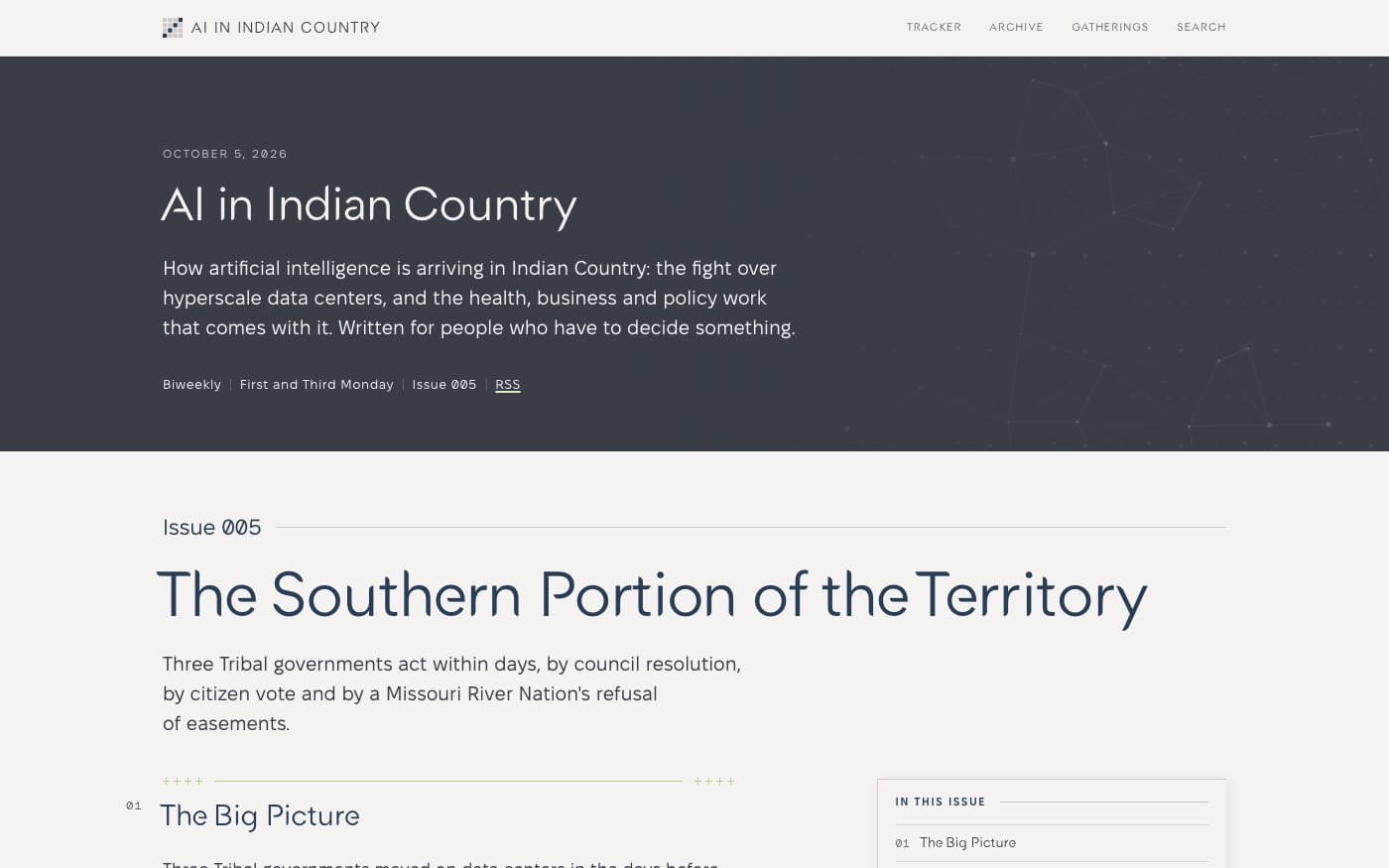
Our own biweekly brief on AI and Indian Country. One place where Tribal leaders can follow the many stories moving at once, with every source linked and every issue kept at a permanent address.
Why it exists
AI is arriving in Indian Country on several fronts at once: a data center proposal near a reservation, a council resolution two states away, a new federal policy, a health program trying out a new tool. Each story turns up in a different outlet, and a Tribal leader preparing for a council meeting has no time to go looking for all of them.
AI in Indian Country pulls those stories into one place. On the first and third Monday of every month, it gathers the recent news, reporting, and public records and sets them out for the people who have to act on them.
Written for people who have to decide something.
Who it is for
Three readers, each with their own decisions in front of them. Tribal leaders and elected officials, weighing AI against community priorities. Department heads and program staff, Tribal and non-Tribal, who need to know what these tools mean for their programs. Tribal attorneys and legal staff, working through data governance and sovereignty. Every page assumes no technical background.
What we built
The brief used to be laid out by hand in Canva, one issue at a time. We gave it a permanent home, where layout is decided once instead of twenty-four times a year.
- Every issue at its own address. A full archive, each issue dated and numbered, so it can be cited in a council packet or a grant narrative.
- The Data Center Tracker. A map and running record of what Tribal Nations have decided about hyperscale data centers, and what they are building themselves, each entry tied to the issue that recorded it.
- Gatherings. A calendar of conferences and deadlines, a year ahead.
- Search. Every story the brief has carried, filterable by topic: data centers, water, sovereignty, policy, consultation, education, and funding.
- A feed for anyone who reads in an RSS reader.
Reporting, kept apart from judgment
Each story links to its source and names who reported it. Where the brief offers its own read, that interpretation sits in a clearly marked block, “What we make of it,” so a reader always knows which part is the record and which part is opinion. Photographs carry credits, and corrections are published in place rather than quietly folded in.
Made with AI, on purpose
A publication about AI is built with it, openly. Each issue is researched and drafted by a scheduled AI task working to a written editorial standard, then reviewed and published by a person. An automated check enforces the rules on every issue before it can go live: it opens with The Big Picture, every story cites a real source, and reporting stays separate from opinion.
A site that keeps itself current
A new issue is added as a single file. The site does the rest: the front page, the archive, search, and the feed all update on their own, and nothing has to be listed by hand. We tested that rather than assuming it.
Where it stands
Live, publishing on schedule, and free to read. No accounts, no subscriptions, no paywall, and nothing to buy.
It is also the studio’s own proof that we can run a publication end to end, from the content model to the Monday it goes out.